Teada & Brian Cunningham

Teada & Brian Cunningham
I am in the back of the Cat’s Cradle in America’s coolest small town, Carrboro, NC. 600 people have packed the place for an acoustic ensemble called Mipso Trio.
500 under 25 years old & 100 of us over 50. Acoustic but definitely
smells of teen spirit.
These are the faces of the new folk revival and it is beautiful. This is what I have spent my life working to return to. I am home in so many ways. Hallelujah.
Contact: Adam Graetz
Marketing Director
(919) 929-2787
FOR IMMEDIATE RELEASE
April 2, 2012
The ArtsCenter Names New Executive Director
|
CARRBORO, NC – The Board of Directors of The ArtsCenter has named veteran non- profit leader Art Menius its new Executive Director, board chair Betsy James announced. Menius will begin work on April 10.
“With a full time Executive Director leading the way, we can now start moving toward that bright future we all foresee for The ArtsCenter,” James said. “Thanks go to the Search Committee, to Interim Executive Director Jay Miller, our faithful volunteers, to the staff and to the Board for keeping us moving in the right direction up until this point.”
“I could not be happier or more excited to be coming home to Carrboro to join the team at The ArtsCenter,” Menius said. “The Board and staff with Jay Miller have done the heavy lifting and toting to get The ArtsCenter on solid footing.”
Menius, a Raleigh native, received both BA and MA degrees in history from the University of North Carolina at Chapel Hill and lived in the Triangle until 2004. Since 1983, he has written about roots music for publications including The Independent and the News & Observer. In 1985, after working on the cable TV series “Fire on the Mountain,” Menius helped create the International Bluegrass Music Association and became the new trade association’s first executive director.
The first president of the Folk Alliance, Menius became its first manager in April 1991, serving in that capacity until June 1996. Menius became Associate Festival Coordinator for Merlefest, the enormous outdoor folk festival presented by Wilkes Community College in Wilkesboro, NC. Following a decade there, Menius served as Director of Appalshop, the acclaimed Appalachian media and arts center in Whitesburg, Kentucky from July 2007 until March 2010. He served as president of the Durham-based Old-Time Music Group, publishers of the Old-Time Herald, from 1992 until 1998, and currently belongs to the Folk Alliance International Board of Directors.
“The future looks exceptionally bright for The ArtsCenter,” Menius said. “We have a bold vision for our growth that will be converted by our staff and Board this summer into specific action plans. The community will be amazed at how far we have come when we celebrate the 40th birthday of the vibrant cultural asset in 2014.”
For interviews with Art Menius, please call 919-675-2787.
Painter Jacques Menache founded the institution in 1975 to encourage artistic development, experimentation and collaboration as ArtSchool comprised of a single painting class above what is now The Armadillo Grill. After moving to Carr Mill Mall and adding vibrant performing arts to its ever expanding classes, it became The ArtsCenter. Continued growth resulted in a move to its current 20,000 square foot location off East Main Street in Carrboro.
One of the most all-inclusive arts centers in the country, offering performance, exhibition and education all under one umbrella and mostly under one roof. The ArtsCenter features two theatres, seven studios and two galleries. The organization serves 60,000 people annually through classes for adults and children, after school programs and presentation of the visual and performing arts. For more information about The ArtsCenter, call 919-929-2787 or visit www.artscenterlive.org.
#### |
RRC Extra No. 28: Austin Hopes and Dreams
Please feel free to forward or post this RRC Extra widely. We only ask that you include the information that anyone can subscribe free of charge by sending their email address to rockrap@aol.com. If you ever wish to unsubscribe, just send an email with “unsubscribe” in the subject line torockrap@aol.com.
The massive South by Southwest music festival (SXSW) has been held in Austin, Texas in the spring of every year since 1987. Dave Marsh reports on this year’s shindig.
I know something about SXSW keynote addresses. Little Richard and Smokey Robinson both did theirs as, in part, dialogues with me—sitting live in front of several hundred people, Richard being Richard, Smokey being serious, sincere, smart, and as handsome as seventy will allow.
To a certain extent, it’s a setup: All the attendees who don’t care find other things to do and most of the rest come to have expectations affirmed. But it’s not that simple either. I had the best fun of the last twenty years just asking four questions, sitting and watching Little Richard rave for (I timed it) 17 and a half minutes without pausing for breath. Then he turned to me, clearly winded, and said breathlessly, “Ohhh, Dave! You’re still here. I bet you want to ask me some more questions.”
But it’s not that simple either. The best moments can also be absolutely pedagogical: Smokey ended with a seven minute spiel telling people how to find and deal with stardom, beginning with an admonition (“Thicken your skin”) and ending with a parable about the invention of show business. Since 2010 that last part’s gotten almost half a million hits on YouTube. Richard, who appeared in ’08, seemed to just rant but in reality he was preaching a sermon on the same theme as Smokey, offering all kinds of nuggets but coming back to the main point over and over again: “Sign your own checks!…Sign your own checks!” Afterwards, a young woman came up to me, eyes a brimful of tears, and said, “Thank you, thank you, that was everything I came here to learn.”
Steve Earle began by lecturing his audience: “Let me make something extremely clear. Kiss is not cool, Kiss was never cool, Kiss will never be cool.”
But Bruce Springsteen, this year, was something else again. He offered career advice wrapped in biography, history complete with instructive examples of where he’d swiped a couple of his classics: the doo-wop crooning that led to “Backstreets,” the way the Animals’ “Don’t Let Me Be Misunderstood” provided the core of “Badlands,” and how and why “We Gotta Get Out of This Place” is “every song I’ve ever written including the new ones.” Rocker he may be, but not rockist: “The elements you’re using don’t matter. Purity of human expression and experience is not confined to guitars, to tubes, to turntables, to microchips. There is no right way, no pure way, of doing it. There’s just doing it.” Bruce wrestled with Lester Bangs and Woody Guthrie, post-authenticity, the transformative self, Roy Orbison’s paranoia, Phil Spector’s musical violence, the cover of Meet the Beatles as “the silent gods of Olympus,” the barely comprehensible existence of Nintendo-core, black death metal, and the yearning needs of soul. It was as if someone had managed to translate “A wop bop a loo bop a wop bam boom tutti frutti” into a comprehensive treatise on the development and meaning (or lack thereof) of the past sixty years of Anglo-American popular music.
He avoided the hard political realities at the core of his new album, Wrecking Ball, in favor of talking eye to eye with an audience he assumed (correctly) consisted of people who either knew these things or needed to find them out. It was a practical speech, aimed at a specific group of people. He didn’t even know it was being broadcast live or, as far as I can tell, imagine that it would wind up all over the Internet, words stuck in the heads of millions of listeners. (The full audio’s at npr.org. It’s also worth looking at the segments posted on YouTube, particularly the stuff about the Animals.)
Raves arrived immediately, but I don’t think anyone’s used the term that best describes it for me: Generosity. The speech gave far more than it took and it held back on self-promotion (granted that the entire speech was wrapped in Bruce’s persona, but I’ve already quoted the only reference to his new album.)
Springsteen never has opening acts. That day he had five. Before the SXSW speech, Jimmy LaFave, Eliza Gilkyson, and Juanes sang Woody Guthrie songs (plus one original by Juanes). It was beautiful and loving, and all the things that a tribute to a great artist on his centenary ought to be. The highlight for me wasn’t Juanes singing a verse from “This Land Is Your Land,” which he told me later was the first time he’d ever sung in English onstage, but Juanes stepping up to challenge the audience when it didn’t sing along heartily enough. LaFave sang wonderfully as he always does, his Oklahoma roots deliberately on display, and his commentary on Woody’s music and life more trenchant than ever. And Eliza, firebrand that she is, kept the music contemporary, insisting on its relevance—or rather, insisting on her listeners paying attention to its continuing relation to the world descended from the one Guthrie described. Eliza has been the best female singer-songwriter for several years now, LaFave has been the best interpreter of Guthrie, Dylan and Springsteen for longer than that, and maybe this performance will help the news spread from Austin. Juanes, of course, is a rock star of Springsteen’s magnitude throughout Latin America and much of Europe; imagine John Lennon in Spanish.
That evening at the Moody Theater Springsteen had two openers–Low Anthem and Alejandro Escovedo with his full band each did about 45 minutes. (Springsteen had done a couple of numbers with Alejandro the night before at the Austin Music Awards show.)
The Austin show was only Springsteen’s second since the release of Wrecking Ball and, like its predecessor—an Apollo Theater benefit in honor of SiriusXM’s tenth anniversary—it contained some beautiful one-off wrinkles. Instead of invoking Curtis Mayfield, Wilson Pickett and Smokey Robinson (and James Brown by way of a lunatic climb into the rigging), this time Woody Guthrie framed the action. Bruce opened with his now-17 member E Street Band doing “I Ain’t Got No Home” a cappella and closed with “This Land is Your Land” with Escovedo, Low Anthem, Joe Ely, and a couple members of Arcade Fire helping out.
Is there another performer in our culture who operates in both the folk-rock and soul-gospel traditions? It’s as fashionable lately to evoke Springsteen as a literary figure as it once was to display him as an articulate pseudo-gas station attendant. But what’s most remarkable is the ability to move smoothly among soul and gospel music and the folk and country tradition in the way that Springsteen does. He has reached the point now that on Wrecking Ball’s “Land of Hope and Dreams” he does both in the same song. Generally, one is lurking in the background of the other in any of his songs, especially live. (Which can’t be discerned if all your attention is on the lyrics which is where, I suppose, the shade of the Great American Poem lurks in the minds of the critics who think it’s mostly about the words.) Yet in pulling these sounds together, Springsteen is capable of convincing more than a few that the beloved community truly could be in our future.
The Wrecking Ball songs (at the Moody he played eight of the eleven) have the strongest connecting thread of any Springsteen album since The River–from the furious social questions of “We Take Care of Our Own,” through the economic despair and determination of “Jack of All Trades” and “Death to My Hometown” to the glorious anthem of hope “Rocky Ground”—with its invocation of God, who does not answer—to the final, unambiguous call to action, “We Are Alive.”
I don’t suppose Bruce Springsteen has a much clearer vision of where, exactly, that action must lead to prevent the “hard times come and hard times go” cycle that he pounds away at six consecutive times in the song “Wrecking Ball.” But you can glimpse what it might feel like in any great musical performance, not just one of his. And, from my perspective, that is the real purpose of SXSW. Truth is, there hasn’t been a commercially important act that broke out of the conference since Hanson, fifteen years ago. But so what? It’s still the biggest, best music school in the United States, maybe the world.
And while Bruce’s show couldn’t offer the kind of community that he evokes in songs like “Land of Hope and Dreams,” it did evoke a sense of musician solidarity that’s essential to what happens with SXSW at its best. It’s a glimpse, but even a full-on Bruce and the E Street Band show is just a glimpse of what it would be like to live with equality and justice every day.
SXSW is as imperfect as any other human project. The sheer size of it has outstripped Austin’s transportation infrastructure and its deficit is ever-widening. The business panels are just the record industry trying to talk itself into believing it still exists. Hip-hop, dance, and ethnic music never get an equal shot in the press coverage and Austin’s local Mexican/Chicano community is invisible.
But.
What SXSW offers is a chance to attend that music school not only as student but as teacher. Not to study music but to observe and participate in the stewing mess of it. I have gone to Austin for this peculiar rite of March madness for the past, I think, nineteen years. I went to speak, I went back to listen. I keep going back not because I think I’m going to find any next big thing, but because I might run into musical glory.
This year, I got it in half a dozen ways—from Bruce, of course, but also from Eric Burdon, whose surprise (even to him and Springsteen) appearance to sing “We Gotta Get Out of This Place” at the Moody was a fiery proof of every accolade heaped upon the Animals’ frontman earlier that day. Where else could I interview, in the space of forty-eight hours both Juanes and Eric Burdon? Where else could I see old Austin friends like LaFave, Gilkyson, Michael Ramos, Michael Fracasso, Joe Ely and the Krayolas? Where else could I spend an afternoon and evening at a taqueria with Alejandro, Jesse Malin, Lenny Kaye, Rosie Flores, and new favorites like Maren Parusel?
Where else could I (with massive help from David Alvarez at KUT-FM and my producer Jim Rotolo) put on a live Sunday radio show, from nine to eleven AM, with seven musical guests? None of them played a record or sang a song I’d ever heard before. And all of them were flat-out great. None of them got paid—at SXSW no artist at an official gig ever gets paid, and very few get paid at any of the others, either. It is, most of the time, music for the love of music.
I go to SXSW to recharge, to remember why I love music, why we’ve still got a chance. And this year, like that young woman said, I got everything I came to learn.—D.M.
I See Hawks in LA A New Kind of Lonely (Western Seeds Records)
Review by Art Menius for http://artmenius.com

An old joke defines a gentleman as someone who knows how to play bluegrass music, but chooses not to do so. I See Hawks in LA offers a west coast style of acoustic music that draws deeply on bluegrass without ever becoming bluegrass except for “Hunger Mountain Breakdown Those who remember Kate Wolf will know that of which I speak and will likely love I See Hawks in LA.
Their sixth CD in a 13-year career, A New Kind of Lonely, features entirely original songs, lovely musicianship, and an open, welcoming vibe. “I Fell in Love With the Grateful Dead” captures much of the spirit of the album and the band. While that is a straight up love song to a special scene, I See Hawks in LA possesses a true facility for contrasting the music and lyrics. .” The “breakdown” in the title of “Hunger Mountain Breakdown” turns out to be a double entendre, for example, since the protagonist is pondering jumping off a cliff. “I know that if I am up here on this mountain, my problems will soon end.” “Big Old Hypodermic Needle” is an upbeat country song about overdosing on heroin.
They also have a literary inclination, which certainly distinguishes their songwriting from bluegrass compositions. “Dear Flash” is inspired by Gurney Norman’s novel Divine Rights Trip, the novel that appeared in the Last Whole Earth Catalog. As we know, Gurney hung out with the Grateful Dead when they were still called the Warlocks. “Mary Austin Sky,” on the other hand, draws inspiration from the painter Mary-Austin Klein with the wondrous opening line “even mundane objects are beautiful.”
The trio of Rob Waller (lead vocals, guitar), Paul Lacques (guitar, Dobro), and Paul Marshall (electric and upright bass) comprises I See Hawks in LA. Waller and Lacques serve as the primary songwriters. A number of guest musicians, including the fantastic southern California fiddler Gabe Witcher, help out.
By now you may have noticed a lot of references to the 1970s. It is hard to listen to this most enjoyable album without feeling the 70s groove. It is not unfair to file A New Kind of Lonely under granola music for the early 21st century. Whether you are nostalgic or just enjoy top notch songwriting, social commentary, and acoustic guitar picking, you will appreciate A New Kind of Lonely by I See Hawks in LA.
You can sample some of the cuts at http://www.iseehawks.com/store

-30-
Book Review
By Art Menius for Artmenius.com March 2, 2012
Scott Alarick, Revival: A Folk Music Novel (Portsmouth: Peter E. Randall, 2011), 312 pp.

Click above to purchase via Amazon
Revival is a serious and important book about folk music that takes the form of a page turning novel. And, believe me, for anyone in the folk world, Revival is a page turner. Alarick delivers a fabulous introduction to the folk music world and as clear an exposition of the connections between the contemporary scene and folk traditions as can be found anywhere.
To say it is an excellent book is not the same as saying it is a great novel. Revival is not that, although consistently entertaining and well written. This, however, is one of those books – 100 years ago they were common; think Theodore Dreiser, Sinclair Lewis, or Upton Sinclair – where the ideas explored are more significant than the story or typical character development. Scott could have posited his ideas in non-fiction form. I have heard him do in lectures. Instead, he employed a more entertaining method.
An exchange on page 243 captures the central thrust of Revival – a simple proposition that those who want to move forward must know the past. The protagonist, Nathan Warren, legendary in northeastern folk circles for his almost was a star status, is dining with old friend Ferguson. The latter is a freelance music writer for the Boston Globe. Where did Scott, who spent a score in that role, get the idea for that character?
‘All people’s music,’ Ferguson said.
‘Exactly. It is authentic because it’s real, not because it’s old, or Irish, or Appalachian. That is so hip. It took me years to figure it out.’
‘There’s a funny thing about purists,’ Ferguson said…. “The artists the purists point to are always the people who changed the music. Always. Think about it. In bluegrass, it’s Bill Monroe and the Stanley Brothers…. Purists set the rules by exalting those who broke the rules….’
Nathan let out a long breath, still looking out the window. ‘And that’s how the big river keeps rolling along, isn’t it? We spend part of our lives thinking we’re rebelling and part of our lives thinking we’re resisting rebellion. But we are always doing what the big river wants. What the tradition wants. Taking it up and passing it on.’
The plot is more that of a film than a novel. Nathan is living a middle aged fantasy – a second lease on life thanks to a passionate affair with a much younger singer, songwriter, and fiddler, Kit Palmer. James Mason made a career playing these parts on screen. Nowadays, I’ll cast Steve Earle as Nathan; Paul Giomani as Ferguson, Melissa Leo as Jackie the bartender, and classically trained musician-turned-actress Lucia Micarelli, the street fiddler on Treme, as Kit. Both because of and in spite of Nathan’s help, her career has taken off. Not entirely unlike when 22-year-old harmonica player Annie Raines met Paul Rishell, the country blues guitar player twenty years her senior, in a Boston bar in 1992, and formed a durable partnership.
As their relationship and Kit’s career blossom, Nathan examines his life. He explores how to get out of his own way, and hers, at mid-age, as well as The role of elders in the folk community. . This drives the plot.
Of more interest, perhaps fascination, for most readers will be the myriad details ring true for any veteran of the folk world. Scott takes the reader on an inside tour through the New England folk community of the past thirty years. Some real people prove obvious, such as Betsy Siglin as Betsy Stotts. Others are less clear, more likely compilations.
A disquisition on why some singer-songwriters succeed both artistically and careerwise, Revival also concerns itself with the meaning of home and how to get back there as much as the “Wizard of Oz.” Alarick’s home is the Boston folk scene. He brings it to life on the pages of Revival.
-30 –
By Art Menius 3/1/2012
This folk revival has legs beyond what happened fifty years ago. This one is not as obvious because it has depth, built to last, no apt to make some pop stars then fracture into many different scenes. The 21st Century folk revival comes up from these many genre related scenes, not from the top down. This movement comes from a sustainable direction. The myriad musical interests of today’s youth connect these worlds in a way consistent with Clark and Elaine Weissman’s vision for the Folk Alliance.
The folk big tent thrives. It covers old-time, singer-songwriter, bluegrass, blues, Celtic, Klezmer, New Orleans jazz, world, and more. It comes to life each year at the Folk Alliance International Conference. These last three years have seen the group grow consistently young with 2012 bringing the tipping point. I am as proud and excited as any grandparent.
The worm has turned. It is a great time to be an elder in folk music as the kids are all right – interested in learning trad and then using it for their own purposes. We have made it through the time when we disconnected from the roots and returned to where tradition informs innovation, where the past fuels change. Some of the young folks are into the politics too. Happy days are here again.
Folk Alliance 2012
By Art Menius for artmenius.com 2/28/2012
Last week brought another Folk Alliance International Conference, the last of a six year cycle in Memphis, Tennessee. Next year brings Toronto, then five years in Kansas City, Missouri starting in 2014. I started attending with the formation conference produced by Clark and Elaine Weissman in 1989. This year’s vintage proved one of the best of the 24 so far. See “History of Folk Alliance Conferences” at the end of this article.
I’ll feature the best new music I gleaned from FAI 2012 on “From the Roots” on WMMT-FM 88.7, Whitesburg, KY this Saturday from 11 AM until 2 PM Eastern. Streams live at wmmtfm.org and on various phone/tablet radio apps. My radio blog lives here.
Adventures in Obligations & Awards
I arrived Tuesday night for the start of many hours of FAI Board meetings that stretched through 4 PM PM on Thursday. Working together, we sorted through some serious matters involving this upcoming transition and the birth in 2014 of an exciting winter music camp. Board work continued on Friday with a celebratory meeting with the FAI Regional leaders marking the consummation of a long awaited formal relationship with the international organization. We enjoyed a delightful reception and conversation on Friday with some potential members of the soon to be formed Advisory Council of Folk Alliance. I was reelected to another year on Ex Comm as Secretary as were incumbents Renee Bodie, President, Michelle Conceison, Veep, and Donald Davidoff, Treas. Chris Frayer joined the Ex Comm team as at large. The board welcomed one new member, Joan Kornblith of Voice of America, and thanked Mike Gormley, Linda Fahey, and Ralph Sutton for their years of service.
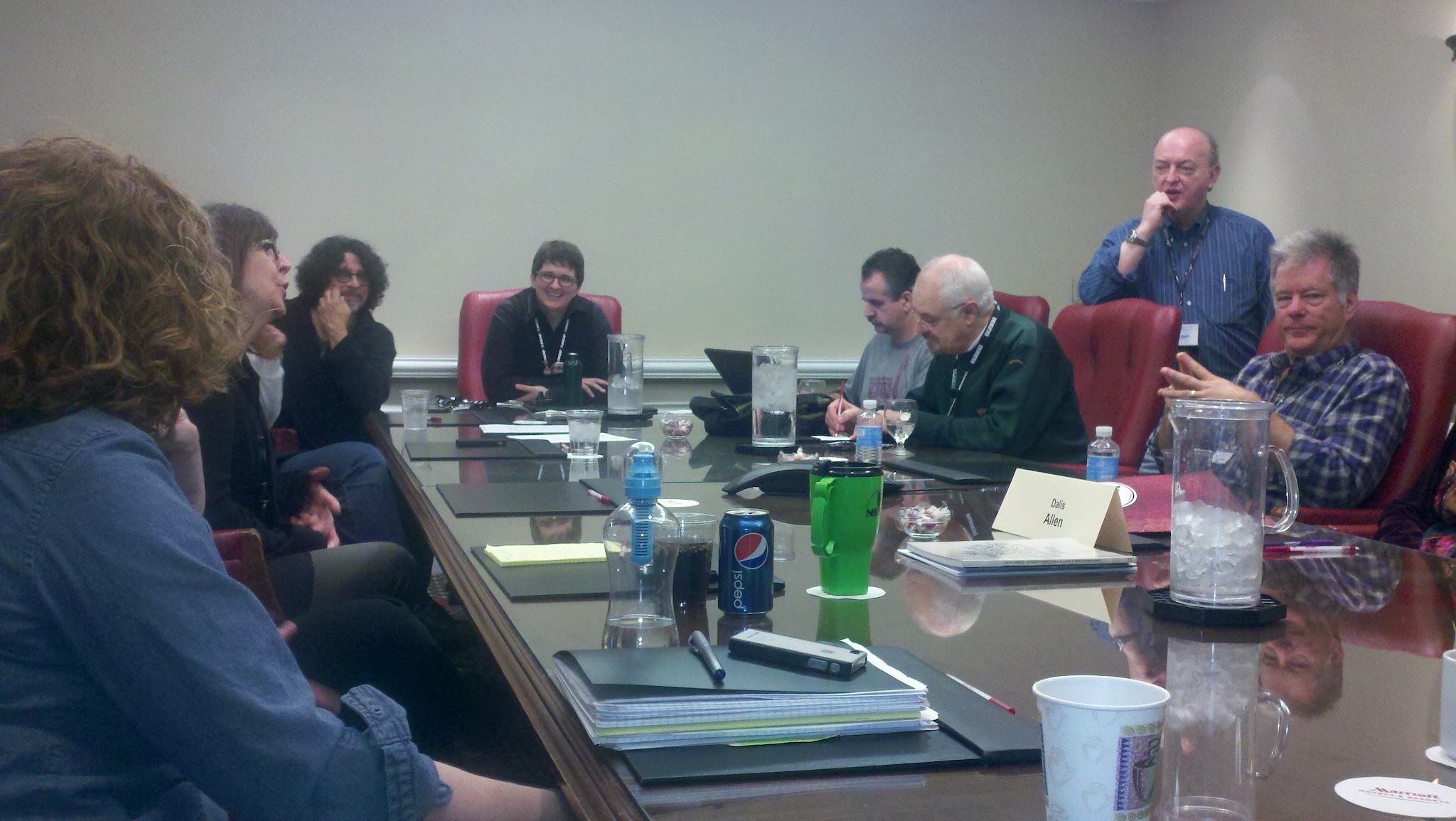
FAI directors and regional leaders 2012
Wednesday evening brought the Elaine Weissman Lifetime Achievement Awards. Scott Alarick again produced fantastic and informative videos for each recipient. As LAA chair, I had the honor of accepting for Harry Belafonte as Living Performer. Most of the LAA videos can be found on here. Pam Michael, current Executive Director, accepted for the Highlander Center. Robert Johnson’s grandsons were there to accept the Legacy LAA and rendered a spirited, electric performance of “Sweet Home Chicago.”
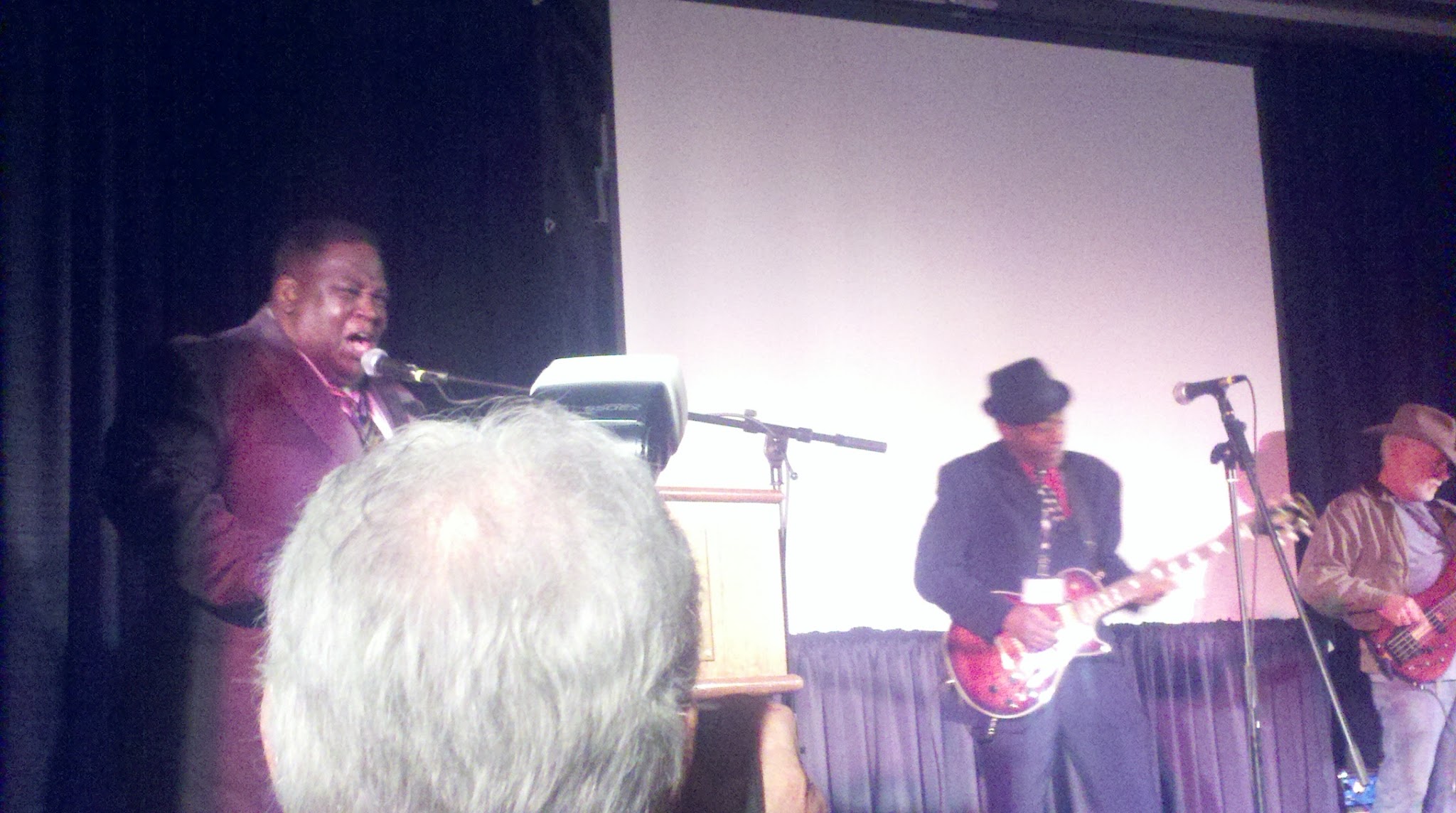
Robert Johnson's grandson singing at LAA
An entertaining interruption of board work, following the least controversial Annual General Membership meeting in history, was the key note interview of Bob Lefsetz by board member Wendy Waldman.
Who is Bob Lefsetz?
When one says and writes as much as Bob Lefsetz, especially statements outrageous enough to entertain, the quality remains variable. One can read this article about him from the current Wired Magazine. That said, Lefsetz connects with spot on accuracy some of the time, and always provides something to talk about. Highlights from his keynote Interview included:
“You have to be good enough that agents and labels come to you.”
“Mumford & son broke; the folk ghetto no longer exists.”
“I want to go to Youtube and see you play live.”
“Twitter is information, not self-promotion. Let your personality come out.”
“If you’re in this business for the money, quit.”
Lefsetz raved about Memphis and the Folk Alliance. You can start reading with this one.
Music, Lots of Music
And, of course, we had showcases upon showcases, a Coney Island stretching from the most traditional to the most self-involved singer-songwriter and pretty much everything in between. They ranged from bands together for months to one-time hit makers like Jonathan Edwards and Dale Watson. The big buzz acts included Elizabeth Laprelle, a young traditional ballad singer, the gospel Sojourners, the retro-hipster Milk Carton Boys, and the Dunwells, who are live from Leeds and bring to mind Mumford & Son. Lefsetz loved the Dunwells, read this.

Jon Newlin & Elizabeth Laprelle
Elizabeth Laprelle proved an astonishing southwest Virgina young traditional singer. At a tender age she has mastered the acclaimed Madison County, NC ballad style (think “Songcatcher” and the soundtrack for “Cold Mountain”) and become a commanding string band lead vocalist. She is the niece of veteran singer and fiddler Jon Newlin, the husband of the outstanding singer/banjo player Amy Davis and member of such groups as the Hushpuppies and the Maudlin Brothers. Jon now anchors Elizabeth’s band The Fruit Dodgers. LaPrelle is blessed with a timeless voice that projects authenticity. She possesses a magic gift that earned her this year’s Mike Seeger scholarship to Folk Alliance. Her latest album, Bird’s Advice, features Jon and Amy, Jim Lloyd, and her mom. Elizabeth Laprelle is real. ‘Nuff said.

L-R Old Man Luedecke, Matt the Electrician, Kaia Kater
Thursday night I saw the Ola Belle Reed of the 21st century. She is an 18 year old from Winnipeg named Kaia Kater (Hurst) who has been playing banjo for just 5 years and knows every inch of that long neck. Mitch Podolak was her first teacher. She sings the old songs and composes fascinating new tunes describing her sound as “alternative/crunk/folk.” Find her now, including a Phillip Glass cover, at http://www.myspace.com/kaiakaterhurst Banjo playing Canadian singer-songwriter Old Man Lubecke and Austin’s idiosyncratic rising star Matt the Electrician were also terrific on the same set.
The Dust Busters
From Laprelle’s Friday night showcase in one of the trad showcases run by Andy Cohen into the wee hours, meandering led me to a hot set by Brooklyn’s Dustbusters. They gave me an advance on their May CD with John Cohen from the New Lost City Ramblers on Smithsonian-Folkways. These three are clearly eaten up with hard core old-time scouring the old recordings for stuff to fit their high energy, pure trad string band on meth style. The Dustbusters performed at the Country Music Hall of Fame on the way home and opened for Steve Earle and Alison Moorer in early February.

Malcomb Holcombe
Perhaps because of the compressed showcase timeframe, my favorite male singer-songwriter Malcomb Holcombe gave the most focused and effective performance I have ever seen by him in is official showcase on second floor Friday night. FAI president Renee Bodie said he was just as powerful in her room 90 minutes later. I met Malcomb at jam sessions in Asheville in the early 1980s when he was a wild young man with amazing songs. Now, he is a wild acting middle aged married songwriter of extraordinary depth and masterfully economical writing. Seeing Malcomb in these small spaces took me back three decades as did the way Holcombe retains the facial and body contortions that add another layer of expression to his poetry and guitar playing. The St. Louis Room was SRO. It’s reaffirming to see this artist finally getting his due since a glowing profile in the Wall Street Journal. I also enjoyed catching parts of excellent performances by a bunch of other old friends including Kickin’ Grass, Joel Rafael (who presented a big Woody Guthrie tribute show Thursday evening), and Scott Ainslie.

Joel Rafael

Scott Ainslie with diddley bo
Wednesday night I ran into old-time and bluegrass veteran Paul Kovac, one of two people I know from Chardon, Ohio, which would be ripped into the headlines on Monday. Jim Blum from Folk Alley had just given him a CD of one of the two shows he played as one of Bill Monroe’s Blue Grass Boys in 1981. Boy = Girl, Paul’s current effort, is a fun duo with upright bassist Jen Maurer, who also plays in the zydeco-jam band fusion group Mo’ Mojo. They sing romantic duets resembling country and pop styles of a half-century ago, accompanying themselves on banjo and bass. Somehow it ends up sounding more contemporary than atavistic, perhaps because the songs are original.

Atomic Duo
Austin’s Atomic Duo somehow noticed that the 1930s were the highwater marks for both brother duet music and socialism in the USA. So they put the two together. I discovered later than they face paced and hilarious showcase was webcast. “Another Key in the Key Chain” is a brilliant example of masking contemporary commentary with the trappings of the past. Who said we learned nothing from watching “M.A.S.H?” The Atomic Duo offers a compelling reinvention of American folk song.
From the same town, musical time period, and appearing next in the same room were three women who call themselves The Carper Family. Anyone who likes Hot Club of Cowtown will immediately engage with the small ensemble western swing and cowboy sound of the Carper Family. Bass player Melissa Carper has a penned a collection of strong original songs that work perfectly in their take on the retro-hip wave, including “Who R U Texting 2Nite?,” which appears on their Back When CD that features Cindy Cashdollar.

Folk Alliance at Occupy Memphis
On a sunny Saturday afternoon, Andy Cohen led a bunch of volunteer musicians two blocks down Main Street to give a public concert in solidarity with Occupy Memphis. The Memphis Mayor’s office helped make it happen.
Workshops and Panels
Board service means that our directors miss all too much of the workshop and panel sessions.

Hazel Dickens Remembered
The session on Hazel Dickens seemed all too short. John Lilly had prepared a nice powerpoint of photos and an informative brochure. Mix of singing and stories from John Lilly, Tracy Schwarz, Ginny Hawker, Bill & Louise Kirchen, and Ken Irwin. The stories covered various aspects of her personality, songwriting, music, wisdom, and the ways she touched our lives. A completed but unreleased album should appear in a few months. Ken has not yet begun going through her many cassettes for what might be hidden there. Bill Kirchen said he regretted that they did not record the honky-tonk album they had discussed. Bill and Louise took Hazel to a John Lilly concerts just days before she passed. They sang all the way back to her apartment. One tale reminded me of how Hazel would always inspect my wife Becky Johnson before the IBMA Awards shows. You can watch the 2002 LAA video for Hazel Dickens here. My obit for the FAI newsletter lives here.
Saturday morning also offered an exemplary conversation about festivals that benefited from the diversity Louis Meyers structured into the panelists. The previous day I made my debut as a Maryland resident in attending the NERFA session rather than my previous home in SERFA.
We had a wonderful conversation that could have gone on forever in the session Pam McMichael and I hosted about the Highlander Center. Wanda Fisher from WAMC radio offered a first person account of frequenting there as a UT student to the consternation of her dorm mother, while Dave Marsh of SiriusXM and Bau Graves from the Old-Town School of Folk Music offered challenging perspectives.
The 2012 FAI Conference provided a blissful last time around in Memphis, arguably the best of our six efforts on the bluffs above the Mississippi. Well see you in Toronto next year and hence in Kansas City.
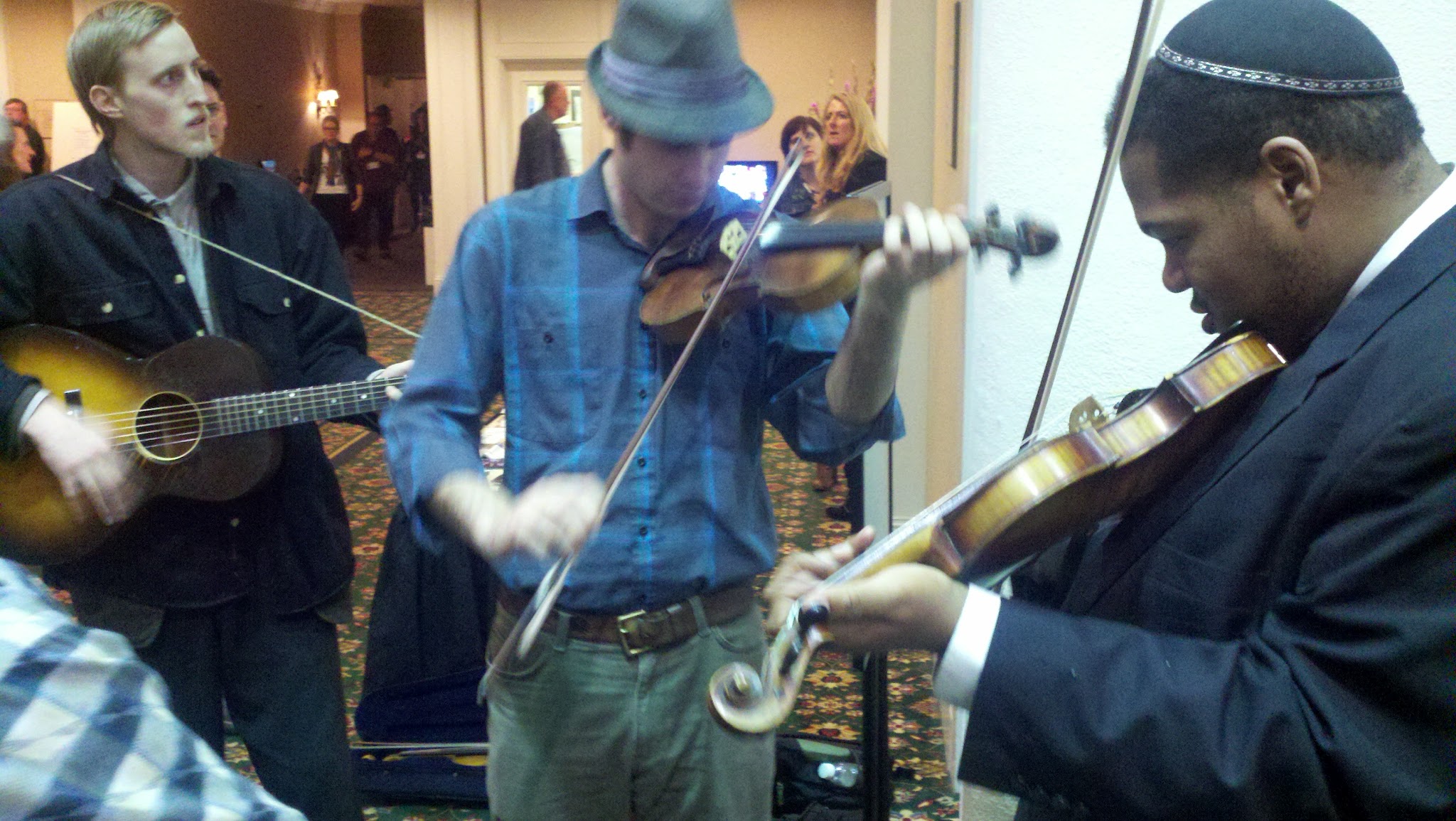
Jeron Big Boy Paxton fiddling with Dust Busters
History of Folk Alliance Conferences
7 Produced by Louis Jay Meyers, so far
2007 – 2012 – Memphis, TN
2006 – Austin, TX
9 Produced by Phyllis Barney
2005 – Montreal, PQ
2004 – San Diego, CA
2003 – Nashville, TN
2002 – Jacksonville, FL
2001 – Vancouver, BC
2000 – Cleveland, OH
1999 – Albuquerque, NM
1998 – Memphis, TN
1997 – Toronto, ON
6 Produced by Art Menius & local committees
1996 – Washington, DC
1995 – Portland, OR
1994 – Boston, MA
1993 – Tucson, AZ
1992 – Calgary, AB
1991 – Chicago, IL
Produced by Philadelphia Folk Song Society & FA Steering Committee
1990 – Philadelphia, PA
Produced by Clark & Elaine Weissman
1989 – Malibu, CA
-30-
And then we have Elizabeth Laprelle, a southwest Virgina young traditional singer and banjo player. Along with the gospel Sojourners, the retrohip Milk Carton Boys, and the Dunwells, she was one of the buzz, up and coming stars of Folk Alliance 2012. At a tender age she has mastered the Madison County ballad style and become a strong string band lead vocalist. Niece of Jon Newlin, she is blessed with a timeless voice that projects authenticity. She possess a magic gift that earned her this year’s Mike Seeger scholarship to Folk Alliance. Her latest album, Bird’s Advice, features Jon and Amy Davis. Elizabeth Laprelle is real. ‘Nuff said.

I have just seen the Ola Belle Reed of the 21st century. She is an 18 year old from Winnipeg named Kaia Kater (Hurst) who has been playing banjo
for just 5 years and knows every inch of that long neck. Mitch Podolak was her first teacher. She sings the old songs and composes fascinating
new tunes describing her sound as alternative/crunk/folk. Find her now, including a Phillip Glass cover, at http://www.myspace.com/kaiakaterhurst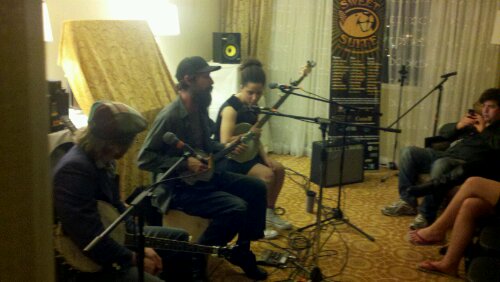
Old Man Lubecke, Matt the Electrician, Kaia Kater in the Sweet Beaver Suite at Folk Alliance International Conference 2012
 Art Menius