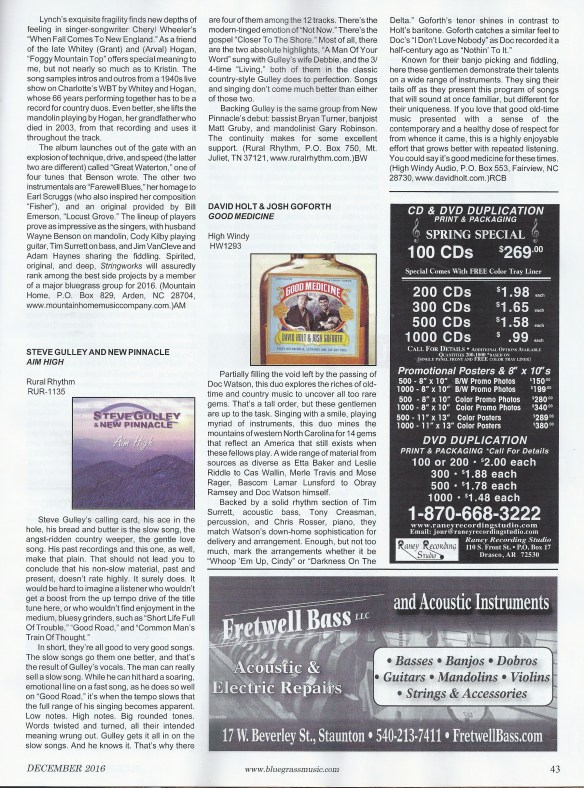
After a tragic Raleigh accident, Hiroshi Arakawa aims to play bluegrass again


After a tragic Raleigh accident, Hiroshi Arakawa aims to play bluegrass again

As he spoke, a scar on Arakawa’s throat was still visible – marker of a horrific Thanksgiving car accident that hospitalized him for 72 days. Always slightly built, Arakawa looked even thinner after 10 weeks in the hospital, nearly half of it with a trachea tube.

Arakawa finally got out of the hospital last week and is staying with friends in Raleigh before going home to Japan in March. Eventually he’ll come back to America and try to pick up where he was in the bluegrass program at East Tennessee State University

http://www.newsobserver.com/entertainment/music-news-reviews/on-the-beat-blog/article131430629.html

Memories of Alan Jabbour in the Field: Visiting the Hammons Family | Folklife Today


http://blogs.loc.gov/folklife/2017/02/memories-of-alan-jabbour-in-the-field-visiting-the-hammons-family/?loclr=eaftb

This recollection is in memory of the Center’s founding director, Alan Jabbour, who died on January 13, 2017, and whose career and contributions are described in this blog post.  Today’s text and photographs are by Carl Fleischhauer, a retired American Folklife Center staff member and a colleague of Alan’s for 46 years

Why Phil Ochs is the obscure ’60s folk singer America needs in 2017 – The Washington Post


https://www.washingtonpost.com/posteverything/wp/2017/01/24/why-phil-ochs-is-the-obscure-60s-folk-singer-america-needs-in-2017/?hpid=hp_hp-cards_hp-card-posteverything%3Ahomepage%2Fcard&utm_term=.b14352c60a35

It isn’t often that Ochs, who died four decades ago and is mostly unknown to those born since the 1970s, gets even a brief moment of mainstream recognition. Yet as we enter the Trump era, and as a new mass protest movement begins to take shape, his music would be worthy of a revival. Taken together, his songs offer an exceptionally compelling tour of the deepest questions currently confronting liberals — questions about democracy, dissent and human decency in a grim political age.

Phil Cohen: From Chapel Hill bus driver to labor activist to author: My Jan 22 2017 Chapel Hill News column


Phil Cohen: From Chapel Hill bus driver to labor activist to author

http://www.newsobserver.com/news/local/community/chapel-hill-news/article127079049.html

Once a gypsy cab driver, he became a labor union organizer. His experience in the local for Chapel Hill bus drivers thrust him into textile union work and a bitter struggle in Jackson, Tennessee. Last summer the University of Tennessee Press published his book recounting that battle between workers and owners

Autocracy: Rules for Survival | by Masha Gessen | NYR Daily | The New York Review of Books


http://www.nybooks.com/daily/2016/11/10/trump-election-autocracy-rules-for-survival/

But Trump is anything but a regular politician and this has been anything but a regular election. Trump will be only the fourth candidate in history and the second in more than a century to win the presidency after losing the popular vote. He is also probably the first candidate in history to win the presidency despite having been shown repeatedly by the national media to be a chronic liar, sexual predator, serial tax-avoider, and race-baiter who has attracted the likes of the Ku Klux Klan. Most important, Trump is the first candidate in memory who ran not for president but for autocrat—and won.

I have lived in autocracies most of my life, and have spent much of my career writing about Vladimir Putin’s Russia. I have learned a few rules for surviving in an autocracy and salvaging your sanity and self-respect. It might be worth considering them now:

Sonny Ochs keeps the legacy of Phil Ochs alive | Hudson Valley One


http://hudsonvalleyone.com/2017/01/08/sonny-ochs-keeps-the-legacy-of-phil-ochs-alive/

NYTimes: How Republics End


How Republics End http://nyti.ms/2hYluPc

A bridge too narrow – Art Menius


A bridge too narrow – Art Menius

My December 4, 2016 Chapel Hill News column 

In theory, kids will ride the bus to school, but many actually walk along the side of the road and across the busy overpass without a pedestrian lane.
http://www.newsobserver.com/news/local/community/chapel-hill-news/chn-opinion/article118314823.html

Folk Music Builds a Civil Society


By Art Menius – September 9, 2014

I believe that our various artistic traditions express a common human thread unifying all people. As the audiences learn about other cultures bridges to understanding are built. They will see how folk music contributes to understanding different traditions and building civil society.

When NEH Chairman Jim Leach asked, “We have a unique national culture with a mosaic of subcultures. A critical question is whether we treat our many cultural differences with dignity and respect and as opportunities to grow and learn, or as divisive traumas worthy of warring over.”

Marginalized cultures generally do not have great access to public forums, but traditional artists from these same cultures can achieve such access, and in doing so, speak for their communities through their art. Their work contains the “mirror effect” that reflects to the outside world the mores of the cultures in which they originated.

“Folk art is important to society because it portrays social and historical aspects of areas or times that changed or lost. Folk artists are often barometers of the popular culture. In most cases, folk artists engage in depicting socially familiar ideas and themes in their art,” wrote Simone Alter Muri (“Folk Art and Outsider Art: Acknowledging Social Issues in Art Education,” Art Education 52:4 (July 1999). Muri argued that the traditional arts fostered social awareness; building tolerance for diversity and helping children understand community.

Whether music, food, or crafts, the folk arts do not happen in a vacuum. The fretless banjo asks us to wonder where the instrument came from and when. When we understand that the banjo originally came from West Africa, it asks us to look closely at the history of immigration. When we know the history of Native Americans in the southern Appalachians, it asks us to look closely at the various crafts and architecture that typifies the Appalachian homesteads and communities. Scots-Irish mountaineers learned to build chimneys from Native Americans who learned from French trappers. Embroidered Mexican scarves/napkins, used to wrap and carry tortillas on journeys of desert immigration embody contemporary issues.

The key becomes how to draw people out of their silos and let them see the connection that inspired me 40 years ago – that moment of revelation when I realized that living Piedmont bluesman John Jackson and long deceased 1920s string band leader Charlie Poole were playing out of the same common repertoire.

I have an especial interest in connecting the folklore, ethnomusicology, and the humanities to musical performance by master musicians, what folklorist Carl von Sydow called “active” tradition-bearers. I envision residencies with active tradition bearers demonstrating and teaching in partnership with a variety of humanities experts. Audiences will not just learn about the outcomes produced by humanities scholarship, but will understand how its disciplines shed light on the human condition.

The tradition bearer will gain from both the association with new audiences and from the attention of the students and scholars. Working with them as teachers will provide new insights in the humanities, their work, and their home communities. Gregory Hansen (“Folklife in Education and Cultural Conservation” (1994) described this from his six years work bringing traditional artists into Jacksonville, Florida schools:

Cultural expressions that the tradition-bearers felt were devalued within their own communities were showcased in the classroom presentations, and the tradition-bearers appreciated the opportunity to share their history and culture with young people. All of the folk artists and musicians whom I interviewed perceived that the school presentations were not only helping to preserve their culture but the sessions also encouraged outsiders’ appreciation of their traditions.

In this sense, both artists and the art they practice reflect and create community and serve as its teachers.

[Photo by Becky Johnson]
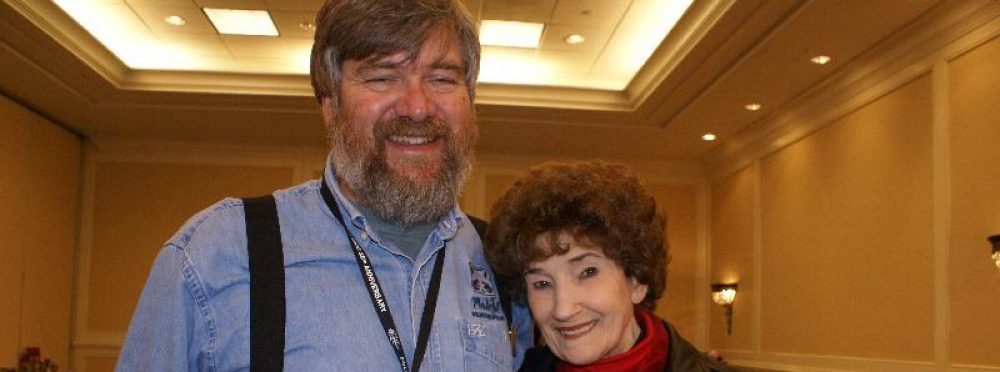
Glowing Bluegrass Unlimited Review for Holt & Goforth


cover-bottle1d

Good Medicine by David Holt and Josh Goforth reviewed in Bluegrass Unlimited December 2016 issue. “This is a highly enjoyable effort that grows better with repeated listening.”

good-medicine-bu-review-dec-2016

Download review as PDF good-medicine-bu-review