Joe Thompson Passes


Joe Thompson was 93 and he was my friend. Joe Thompson died today, almost 20 years after his banjo playing cousin Odell was killed at MerleFest right in front of Bob Carlin’s eyes on Rt 421.
Joe and his fiddle are silent now. The link gone to a lost world of African American string band music. Joe saw young folks take up the music,  but they never knew Jim Crow or what it was like to be the only black face at a white dance.
Joe Thompson is gone and with him the last living link to the world of my grandparents.

Folk Alliance Conference


I’ll be hosting two workshops at the Folk Alliance International (FAI) Conference in Memphis this Wednesday through Saturday. For the full 411, just go to folk.org. This is the best music conference of the year. Don’t miss it.

I’m also chair of the Lifetime Achievement Awards which will be presented Wednesday at 6 PM Central to the Harry Belafonte, Robert Johnson, and the Highlander Center.

I’ll look forward to seeing you all there.

FRIDAY
2:00pm
STUDY: The Highlander Center (Chattanooga)
For 80 years, the Highlander Center has been a progressive oasis in the
mid-South. As such, the history of the Highlander Center, one of this year’s
LAA recipients, is tied to folk and traditional music. From the outset,
Highlander integrated cultural work into all its programs, helping spread
songs like “We Shall Overcome” from striking tobacco workers in the 1940’s
to civil rights leaders in Nashville in 1960, after which it spread across
the globe. Over the years, Highlander’s work has been central to the union
movement, the civil rights movement, the struggle for economic justice in
Appalachia, the environmental movement, and international struggles against
globalization. And through it all, figures like Zilphia Horton, Guy and
Candie Carawan, and Jane Sapp have used music, drama, dance, and stories to
help empower ordinary people in their work for social justice. The Center
continues to provide education and resources for activists across the South
and around the world.
Hosted by: Art Menius artmenius.com
Pam McMichael, The Highlander Center

SATURDAY
1:30pm
Voices from the Cultural Battlefront Session (Chattanooga)
Our Voices from the Cultural Battlefront session continues our work of the
past four years providing a safe space for talking and working together
concerning the meaning of artistic endeavor and the role of artists in
social activism. Voices revolves around the concept that when commerce becomes more important than culture, society atrophies. Hosted by Art Menius Art Menius at your Service

Among many other great sessions Louis has lined up for us this year, I would
also like to point out:
FRIDAY 11:00 AM
Activism (Heritage 4)
What does it mean to be an activist in today’s society?
Dave Marsh, Journalist (m)
Eliza Gilkyson, Artist

Meanwhile, Andy Cohen is organizing an action in solidarity with Occupy Memphis

Imagining America Call for Proposals


2012 Imagining America National Conference

October 5-7, 2012, New York, NY

Linked Fates and Futures: Communities and Campuses as Equitable Partners?


Co-hosted by Caribbean Cultural Center African Diaspora Institute, Columbia University, New York University,  and The New School

Slashed budgets, debt burdens, speculation unchecked, diminished access, narrowing measures of worth. Without support for a reorientation of values and realignment of priorities, higher education and community organizations committed to a just, equitable, and fully participatory vision of the world face a challenge to their most cherished ideals and in some cases, their very survival. Against these forces of unequal benefit, induced scarcity, and reduced expectation, this is a moment that calls for a bold and ambitious voicing of where our desired future lies and how we will get there.


The 2012 Imagining America conference, to be held in New York City, October 5-7, is an occasion to reflect critically on the shared predicaments of democratically-oriented, cultural work in higher education and community-based organizations; to articulate languages and practices of possibility; and to develop and strengthen cross-sectoral networks committed to moving such work forward. The conference is grounded in approaches and experience of the arts, humanities and design drawn from both academic and community knowledge—which is at once local, national, and global. Our aim is to craft a strategic, mobilizing, and policy-savvy framework for sustainable and mutually beneficial relationships that advances full participation of all constituents in the range of decisions that affect our common future.  Building equitable partnerships among higher education and community organizations into its design, the conference aims to develop and disseminate critical, collaborative, and creative forms of new knowledge and leadership. We seek to enlarge the scope of who participates in learning and knowledge production; how that knowledge is generated, valued, and shared; and how to develop solutions to the dilemmas we face. The work we undertake now will build conditions and relationships that are needed to address the crises facing our communities and institutions and enable us to reimagine and remake our future.


The IA conference will explore where campus and community fates are linked and how theory and practice, aspiration and action can be fruitfully entwined. The over-arching framework of the three day conference brings together New York City-based programming with initiatives taking place around the country. To maximize our work together, we ask all who submit proposals to take this framework into consideration and to place their own work in dialogue with the locally generated themes if possible.

The three days will be structured as follows: The first day begins with plenary sessions that include perspectives on shared visions and challenges from people positioned in higher education, community, and policy, with afternoon sessions taking place at various community sites around New York City. The second day incorporates report-backs from and performances based upon the activities and conversations from the first day and focuses on narratives of possibility and innovation. The concluding day is about identifying implications for institutional sustainability for public-minded campuses and community organizations, IA’s own organizational capacity, and national policy.

Sessions will embody multiple formats for public engagement that integrate different ways of knowing, foregrounding the role of humanities, arts, and design. Integrating insights from community, education, and policy, three large thematic areas will be explored:


1) Full, Equitable Partnerships: All manner of partnerships and collaborations have formed between campuses and communities. What makes for effective and sustainable partnerships between higher education and cultural and community organizations? Who is involved in teaching and learning, hiring, curriculum design? Where and for whom are programs designed, and what is their long term impact? The aim is to develop a partnership framework that could be adopted nationally.

Partnerships also raise the issue of organizational sustainability. While higher education looks to be headed for a tuition and debt bubble, many cultural organizations, community-based and otherwise-situated, face dim prospects of survival. Given constraints in both the for-profit and nonprofit models, what alternative organizational forms are available?  How might resources be pooled and shared more effectively?  How might research and investigative capacities of higher education be channeled to serve the needs of community organizations, and reciprocally, how might community-based expertises be integrated more deliberately in higher ed?


2) Linking Diversity and Engagement: The success and sustainability of initiatives aimed at full participation and public engagement depend upon linking both and building them into the hard-wiring of institutions.  This theme builds on IA’s ongoing Linking project, which asks:

  • How does the goal of increasing institutional diversity and full participation interact with developing the capacity and commitment to address tough problems facing multiple communities? What strategies and frameworks enable these linkages to form and last?
  • How do activities, relationships and resources cluster to become arenas for promoting broader sustainable change? How do change and policy leaders build out systematically from hubs and hot spots at the forefront of change? What can one initiative learn from another about that building out process?
  • How can arts, design, and humanities serve as particular vehicles for linking diversity/ inclusion with public scholarship/ engagement?


3) Arts, Culture, and Community and Economic Development: Higher education institutions and government agencies have long directed their resources and investments in ways that decisively impact surrounding communities. What approaches to equitable community and economic development strengthen local neighborhoods? What kinds of decision-making, policy frameworks and incentives would be productive for under-resourced populations and institutions? What do self determined approaches look like that draw on local community assets? What kinds of organizing and organizational leadership is needed to advance these common goals, and how can the arts and culture contribute?


Imagining America invites you to consider your work in dialogue with one of the above themes, and in the arc of the conference. Running through all of the above we invite sessions that articulate the role of youth. We also welcome a cadre of proposals that do not fit in this framework but nevertheless advance engaged theory and practice through open and critical dialogue with other conference participants. IA is particularly interested in proposals that contribute to ongoing areas of interest to our members, namely engaged practices in humanities, arts, and design as they intersect with: the environment and climate change; public health; incarceration and reentry; feminism and feminist activism;  faith/spirituality; and international engagement.


The submission deadline is Monday, April 23.
Warren Hellman Memorial


By Art Menius, February 19, 2012

Looks like the Warren Hellman Fest has reached its end – Emmy Lou Harris, Kevin Welch and Keiran Kane, Buddy Miller, John Doe, Gillian Welch & David Rawlings, Robert Earl Keen, Jimmie Dale Gilmore, and Old Crow Medicine Show and stage for the finale. Earlier Steve Earle, John Doe, Boz Scaggs, and Dry Branch Fire Squad performed.

From the free webcast of the free outdoor festival, I have no way of estimating the size of the audience. People went back as far as he camera could capture. Two stages kept the show moving swiftly to its conclusion with the Go to Hell Man Clan singing “I’ll Fly Away” and “Big Rock Candy Mountain.” The weather broke sunny, fortunately, for the event at the beach, rather than the rechristened Hellman Hollow where Hardly Strictly will continue each October.

The Heather Berry & Tony Mabe Show


Heather Berry & Tony Mabe The Heather Berry & Tony Mabe Show (Mountain Fever Records)

Review by Art Menius for http://artmenius.com

The Heather Berry & Tony Mabe Show

North Carolina’s Heather Berry and Tony Mabe have found a wonderful niche in country couples duet music, from whence sprang folks from Lula Belle and Scotty Wiseman (Old Mountain Dew,” “Have I Told You Lately that I Love You”) to Robin & Linda Williams. Supported by Tom T. and Dixie Hall, who placed nine songs on their previous outing, Before Bluegrass,  and aided on the new Heather Berry & Tony Mabe Show by Darrin Vincent, Jamie Collins, and Randy Cook, the pair offers a delightful blend of a 1940s sound, classic and original material, and the sublime enthusiasm of young lovers of traditional music.

Heather and Tony are some of the finest singers of Carter Family material of their generation. This project offers a version of “Little Darling, Pal of Mine” that I shall be playing on my WMMT-FM radio show a lot along with the straight up old-time “Live the Right Life Now.” Yet, they also venture out of their comfort zone successfully on the more contemporary (actually somewhat “Gentle on My Mind” sounding) “I Miss You Old Friend.” The different setting proves that Heather’s voice is everything Dixie and Tom T. say it is. Not that they are adverse to bluegrass, as demonstrated on “Freight Train,” one of the couple of tracks where Tony gets to sing lead. Heather handles most of the lead vocals, while playing clawhammer banjo, Autoharp, and guitar. Tony primarily picks lead guitar but also banjo and Autoharp.

Berry and Mabe convey an infectious joy in making music together. Despite their youth, they keep both their picking and singing understated like those they endeavor to emulate. Once again, Heather and Tony take us on a charming and consistently pleasant journey through the past.

The Heather Berry and Tony Mabe Show projects a more confident, diverse, and accomplished effort than the quite successfully Before Bluegrass.

-30-

Sarah McQuaid, The Sun Goes On Rising – 3 Track Single


Sarah McQuaid, The Sun Goes On Rising – 3 Track Single (Waterbug Records)

Review by Art Menius for http://artmenius.com

I met Sarah McQuaid at the Folk Alliance International Conference in February 2010. Sarah was born in Spain, grew up in Chicago, lived in Ireland from 1994 to 2007, and now resides in Penzance, Cornwall. She performs her own carefully crafted originals along with traditional songs and ballads from Ireland and America. Her second album, I Won’t Go Home ‘Til Morning, provided her interpretations of American traditional music CD.

The three song single, The Sun Goes On Rising, however, demonstrates her artistic growth and an emphasis on her original music. In her hands, John Martyn’s “Solid Air” sounds much more like Joni Mitchell than Appalachian ballad singing with the horn backup lending it an understated jazz feel. The title cut, which she co-wrote with Gerry O’Beirne, provides original music by a contemporary artist grounded in traditional song. Backed by a small ensemble, it shows that Sarah is evolving rapidly as a lyricist, becoming a musical creator rather than an interpreter of the old songs. Not that McQuaid has abandoned the traditional. On the 16th Century tune “The Duke of Somersette’s Dompe” she delivers precise guitar work that references and mimics the sound of the harpsichord.

The Sun Goes On Rising is a bold development and an artistic risk. Based on these three tracks, I cannot wait for Sarah McQuaid’s next full album, The Plum Tree and the Rose. It will include the two songs heard here.

-30-

Grammy Thoughts


By Art Menius for artmenius.com February 12, 2012

My first Grammy Awards as a lapsed NARAS member after more than a score of watching my people not win reaffirmed my decision. The categories that mattered most to me as voter came and went seemingly in a flash on the Internet only program that Steve Martin called the “daytime Grammys” in a Tweet. Adding NFL players and hot starlets to the presenters does not support any claims to artistic merit in the choices.

Levon Helm, for whom the word “veteran” would short his career by 25 years, won for Best Americana Recording. Thus the great Linda Chorney scare of 2012 was averted without resorting to nuclear weapons. File that under soon to be forgotten controversies.

40% of the Best Rock Song nominees have a banjo in the band. How 2012! The Decemberists and Mumford & Son. Then Taylor Swift pulls out an open-back five-string banjo and an old-time band for her otherwise typical Taylor Swift song. The imagery alone is powerful – popular, young country star with a banjo in her hands in one of her three or four most important appearances of the year.

Also, she demonstrated that one can put on “big show” using those instruments and those images on the big stage that proved way more successful than Nicki Manji, when the latter provided the show’s low point.

Even if bluegrass and Americana along with the single blues category and the regional polyglot concoction into which “my” categories disappeared are exiled to the Internet broadcast, banjo fever continues unabated.

Banjo congrats to Bela Fleck for the Best Instrumental Recording award.

More banjo in the Glen Campbell tribute by, I think, Glen’s daughter. Might be the last Grammy telecast for “Gentle On My Mind.” Hartford’s song has a had a great run. Same for Glen Campbell. Certainly moving for him to have one last moment in the spotlight while he can still do it and enjoy it. “Rhinestone Cowboy” certainly proves appropriate. The last single my dad ever bought at age 59. I did hear that “where do I go or do I just shut up” at the end.

Think Taylor will ever catch Alison in total Grammys won?

Poor Brian Wilson of the many chins. Sir Paul McCartney even ages better although Brian may have better realized his new music is not what turns the fans on.

Despite the hype, Adele can sing. She had better take care that voice this time around. Great that she covered a Steeldrivers’ song. Adele beats Bon Iver for Song of the Year, but at least the latter was nominated and the Best New Artist is a bit of consolation for him.

Hazel Dickens and her friend Warren Hellman of Hardly Strictly Bluegrass depicted together in the obits shows someone at NARAS is paying attention.

Great to see all of Alison Krauss & Union Station on hand to accept Best Bluegrass Recording and Steve Martin in the audience. With all the Grammys she has won and all the awards and success Martin has had, they could have easily phoned it in. That also demonstrates support for the category. New rules raising the minimum number of entries suggest the attack on the non-TV categories will continue.

Mike Compton and Joe Newberry


Mike Compton and Joe Newberry

Crownsville, MD February 11, 2012

Live performance review by Art Menius for http://artmenius.com


Mike Compton & Joe Newberry (c) Becky Johnson


Mike Compton and Joe Newberry mine one of the more neglected segments of country music history, that period during the 1930s and 1940s when brother duet music was transforming into bluegrass. Few are better equipped for the task with Newberry able to replicate the underappreciated power of Charlie Monroe’s rhythm guitar, while Compton has been acknowledged as a master of Monroe style mandolin playing for three decades. Add Joe’s exquisite open back banjo playing and their simpatico duet singing and you have a two person string band that can move effortlessly from Carter Family songs to “evil harmony laughing” to early bluegrass to Mike’s original tunes and Joe’s songs. Each set contained one of the latter’s compositions that the Gibson Brothers turned into bluegrass hits.

The many highlights of the well-paced show (the clock affirmed each lasted 45 minutes, but they seemed half that) include a reworking of Compton’s “Idle Time,” the title track of second Nashville Bluegrass Band LP a quarter century ago. Stripped down to its essence as a mandolin tune, it opened up a rhythmic thrust beyond the original. Mike, a long time stalwart of the John Hartford String Band, and Joe turned Hartford’s hippie anthem “Tall Buildings” into a convincing brother duet piece.

Compton and Newberry, best known as a member of Big Medicine, are not just veterans, but have found a partner whose music comes from the same place. Just as if on a back porch, they play to and for each other. The audience gets to share the joy the pair finds in doing it.

-30-

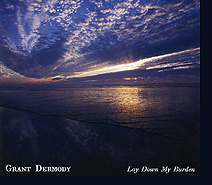
Grant Dermody Lay Down My Burden Review


Grant Dermody, Lay Down My Burden http://www.grantdermody.com/

Reviewed by Art Menius for http://artmenius.com 2/10/2012

Seattle’s Grant Dermody long ago earned a reputation as an excellent harmonica blower equally comfortable in blues, old-time, and roots music while also capable of quite good singing and songwriting. Lay Down My Burden, his late 2011 release featuring more than two-dozen collaborators, marks only his second solo release and first in eight years. He recorded it while processing the passing of his wife, both parents, and mentor John Cephas, who makes his final recorded appearance here. Indeed, Cephas’ lead vocal over his guitar and Dermody’s harp on “Hard Time Killing Floor Blues” from Skip James provides a highlight. The deceased are all pictured in the oddly hard to find CD brochure.

Dermody has gained a good deal of attention over the past couple of years by touring with acclaimed blues guitarist Eric Bibb, whose clear, authoritative guitar playing powers the opening Gary Davis’ cover “I’ll Be Alright” alongside Dermody’s harp and warm voice. Grant has recorded one CD with the old-time ensemble The Improbabillies, whereas his second CD as part of Johnson, Miller & Dermody has appeared since the release of Lay Down My Burden.

“So Sweet,” adapted from John Jackson with additional lyrics, displays again Dermody’s charming singing voice, while showcasing his blowing in a traditional Piedmont blues setting. He gets to visit similar territory with octogenarian Durham bluesman guitarist John Dee Holeman, whose voice belies his age on “You Don’t Have to Go.”

Whatever the genre or group, Dermody fits in because his playing is authentic. The old-time and roots tracks ring just a true as the blues. Grant and Mark Graham turn Henry Whittier’s “Rain Crow Bill” into a raucous two harmonica shout. He and Richie Stearns on delicate, precise banjo provide a winning interpretation of “Waterbound” (which have been playing on WMMT) that leads into an equally successful “Twelve Gates to the City” in a twin mouth harp arrangement. Stephen Foster’s “Hard Times” gets an acapella quartet arrangement that shines. “Amazing Grace” shows his ability to slow down into a deeply soulful groove that sets up Orville Johnson on Dobro and Darick Campbell on lap steel for some engaging jamming. “David’s Cow” proves a fun trio effort to combine both blues and old-time.

Of the original songs, I preferred “First Light” with his hokum feel reminiscent of the African-American string bands that, like Grant, combined blues and old-time. The title track, “Lay Down My Burden,” is a full band electric blues with perhaps too heavy a rhythm section.

Lay My Burden Down is the most down-to-earth, straight from the heart recording with such a large cast of stellar collaborators I have heard by anyone not named Mike Seeger. Grant Dermody and his many friends have produced a lovely hour of honest music from “I’ll Be Alright to the closing Tibetan Buddhist prayer with harmonica and Dobro.

-30-


5 norteno musicians, 4 others killed in Mexico


5 norteno musicians, 4 others killed in Mexico.